
INDEPENDENT DIGITAL STUDY MATERIAL · $19
Mechanical Reasoning & Logic Blueprint
Study gears, pulleys, levers, torque and pressure with 16 worked examples and eight practice questions. An 11-page digital reasoning guide, $19.
Buy Mechanical Reasoning & Logic Blueprint — $19Start the free practice test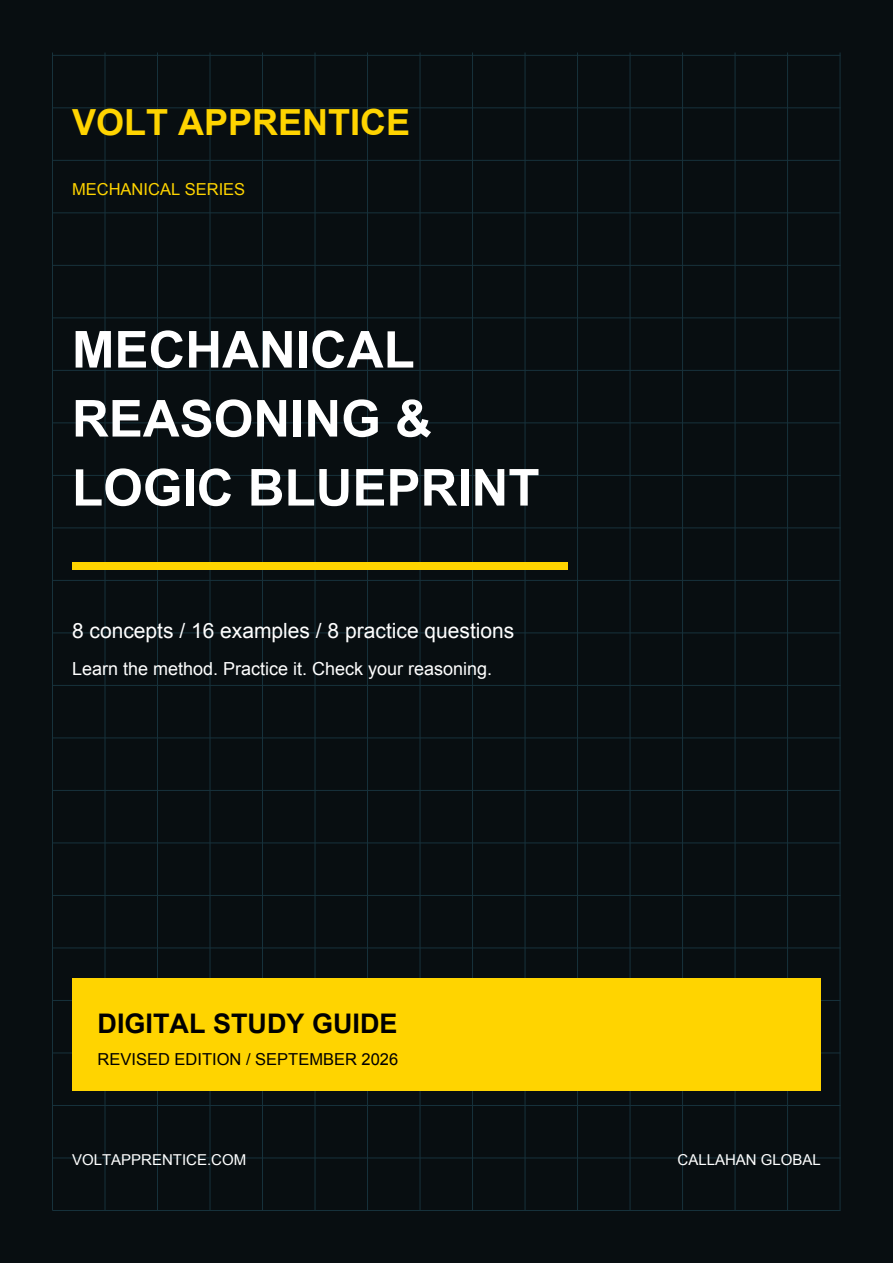
Understand what the mechanism is doing
Mechanical reasoning practice asks you to connect a physical situation with a clear explanation. Which way does a gear turn? What changes when a force acts farther from a pivot? Which assumptions make a pulley calculation valid? Mechanical Reasoning & Logic Blueprint is for learners whose chosen employer, trade or training program assesses these skills, and for people wanting foundational concept practice. You can start without a workshop: the first task is to identify the relationship the question describes.
What your $19 purchase includes
This 11-page digital PDF covers eight concepts: gears, pulleys, levers, torque, fluids, structural stress, balance and heat transfer. It contains 16 worked examples and eight independent practice questions with explanations. The compact format gives you a focused place to revisit the idea, attempt the calculation or direction question, and compare your reasoning with the explanation. It is a conceptual study guide, not a manual for installing, repairing or operating equipment.
Check whether mechanical reasoning is required
There is no single mechanical-reasoning section used by every electrical apprenticeship or employer. Match this guide to the published requirements of your chosen program. The electrical training ALLIANCE's published aptitude examples describe algebra and functions and reading comprehension; that does not establish a universal mechanical test requirement. This product does not claim to reproduce a specific employer assessment or an official entrance exam. If you primarily need algebra or reading practice, review Electrical Aptitude Mastery or the broader Aptitude Practice Foundation workbook instead.
Separate direction from speed
Directly meshing external gears rotate in opposite directions when viewed from the same side. That direction rule does not by itself tell you how fast either gear rotates. A speed question also needs information such as tooth counts. Likewise, a pulley can change a force's direction without creating the mechanical advantage of a moving pulley arrangement. Read which parts are fixed, which parts move, and what the question asks. Keeping direction, force and speed separate helps prevent a familiar diagram from pulling you toward the wrong rule.
Original worked sample: a balanced lever
Consider an ideal lever with a 40-newton downward load two meters left of its pivot. A downward force acts four meters to the right. Ignore the lever's weight and friction, and assume both forces act perpendicular to the lever. What force balances it? The left torque is 40 times 2, or 80 newton-meters. For balance, the opposing torque must also be 80 newton-meters. Divide 80 by 4: the required force is 20 newtons. Check: 20 times 4 equals 80. The longer arm needs less force because the force acts farther from the pivot.
Write the assumptions and units
An ideal-pulley example may ignore friction and pulley weight; a real arrangement need not behave exactly that way. A torque calculation depends on force direction as well as distance. Pressure is force divided by area, so doubling an evenly loaded area while holding force constant halves the average pressure. Write down what remains constant before deciding what increases or decreases. Keep units beside each number. Newtons describe force; newton-meters describe torque. A correct number attached to the wrong quantity is not a complete explanation.
Practice the explanation, then the answer
For each problem, sketch the arrangement and mark the pivot, load, contact or flow direction. State the relationship in words before using numbers. Attempt the question independently, then compare your method with the explanation. If you missed it, identify whether you misread the picture, selected the wrong relationship, or made an arithmetic error. Rework it with different numbers rather than only remembering the original answer. Use a short error log to choose your next concept instead of repeating every topic equally.
Choose focused or broader preparation
Choose this guide when mechanical concepts are the specific skill you want to strengthen. Choose Aptitude Practice Foundation for a wider mix of math, mechanical, reading and spatial practice with a four-week plan. Data Center Technician Readiness is a separate career-interest workbook covering facility concepts and interview preparation. Our free practice test includes five mechanical reasoning questions alongside math and reading. Treat that short practice result as a snapshot, not a certification of ability or a prediction of a hiring decision. These are independent digital study materials; no exam outcome is guaranteed.
Program reference: electrical training ALLIANCE aptitude-test samples. Check your local program for its current requirements.
Study the subject you need next
Buy Mechanical Reasoning & Logic Blueprint — $19Try our free 15-question practice test
Refund and delivery policy · Return to the Volt Apprentice home page